

The 2025 London Connect Forum brought together senior leaders from across the investment industry to explore how asset management is evolving amid shifting macroeconomic conditions, accelerating technology, and changing investor behaviour. Under the theme “Navigating the Next Era of Asset Management,” the half-day event examined how firms can adapt, innovate, and strengthen trust in a market being reshaped by new dynamics.
Setting the Scene: Investing Made Simple
Opening the day, Ross Fox, Head of EMEA at Calastone, illustrated the complexity that underpins even the simplest investor action. He described how a single investment decision can trigger a chain of messages across advisors, custodians, transfer agents and banks – a process expected to work flawlessly but often hidden from view.
Ross emphasised that these invisible mechanics are central to investor confidence, yet friction remains. Only a small fraction of UK adults receive investment advice, while hundreds of billions of pounds still sit in cash. He noted that investing should feel as straightforward and secure as saving, and challenged firms to consider the single biggest change they could make to improve the investor experience.
He pointed to positive momentum across the industry – faster settlement cycles, new platform-transfer initiatives, and the FCA’s targeted support model – all helping to make investing more accessible. His closing challenge was simple: what’s the one improvement that could most empower investors?
From Recovery to Reinvention
Setting the stage for the discussions ahead, Brian Godins, Calastone’s Chief Commercial Officer, joined Dean Frankle, Managing Director and Partner at Boston Consulting Group, to explore how the global funds industry is responding to macro and structural pressures.
Dean shared insights from BCG’s latest Global Asset Management Report, highlighting that global AUM reached record levels in early 2025, yet industry costs continue to rise faster than revenues, an unsustainable trajectory. He outlined three imperatives for reinvention: aligning product mix with growth areas such as alternatives and passives, achieving sufficient scale to compete efficiently, and re-engineering cost bases to focus resources where they add the most value.
He noted that technology must be used not only to automate but to redirect people and capital to the areas that truly matter. Polling among the audience revealed skills shortages and weak business alignment as the biggest barriers to scaling AI, challenges consistent with what BCG sees across its global client base.
Asset Management 3.0 – What’s Next for the Industry
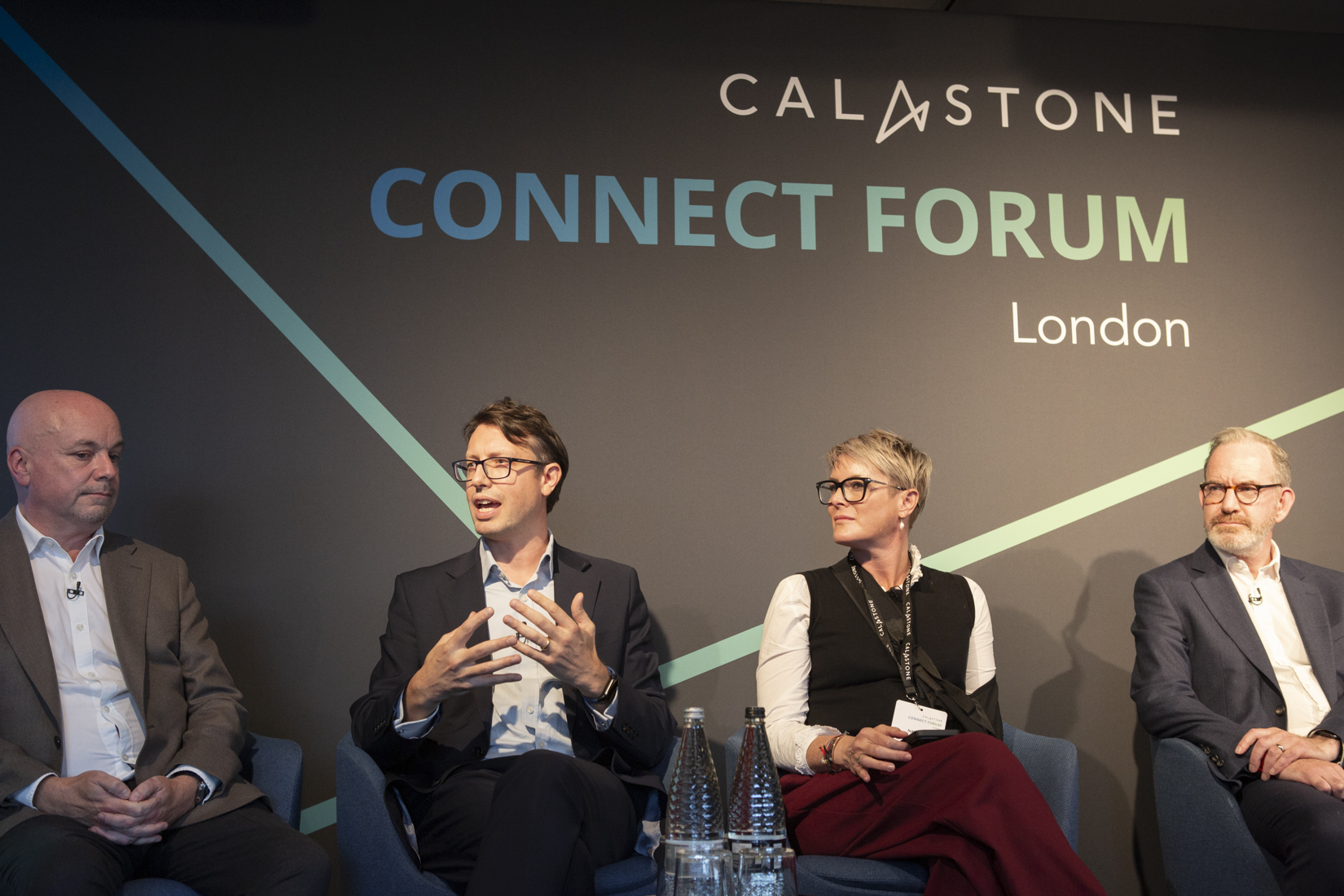
The conversation broadened in a lively panel moderated by Edward Glyn, Calastone’s Head of Global Markets, featuring Jonathan Curry (HSBC), Will Lucken (Janus Henderson), Christophe Caspar (Edmond de Rothschild) and Simon Ellis, independent chair and non-executive director.
Edward framed the debate around the “battle for relevance” – how asset managers can stay differentiated in an environment of compressed margins, digital disruption, and shifting distribution power. The panel explored consolidation, technology, private markets, and the evolving role of active management.
Simon observed that influence in the industry is moving toward distributors, as vertically integrated platforms increasingly determine where margins sit. He suggested that the FCA’s targeted support model would reinforce this trend, as investors grow more comfortable interacting through digital channels rather than advisers.
Will emphasised the importance of collaboration over product push, arguing that tokenisation and blockchain could eventually redefine how investment products are structured, perhaps even making traditional fund formats obsolete. Christophe agreed that while cost discipline is vital, the industry’s growth will come from specialisation, innovation and service quality. Jonathan added that as global wealth shifts toward Asia and the Global South, asset managers must adopt a global mindset and diversify accordingly.
The discussion on the democratisation of private markets was particularly animated. Panellists agreed that private assets will become more accessible to retail investors but warned that expectations around liquidity must be managed carefully to avoid mis-selling. Education, transparency and responsible design were identified as essential.
The conversation turned next to product innovation and active ETFs. The panellists noted that ETFs are increasingly seen as an alternative wrapper for active strategies and that asset managers can no longer afford to ignore this growing demand. Those who fail to adapt, they agreed, risk losing relevance as distribution channels evolve and investors seek greater choice and efficiency.
Converging Forces – Traditional and Decentralised Finance
The theme of convergence continued in the next panel, “Converging Forces: How Traditional and Decentralised Finance Can Evolve Together,” moderated by John Allan, Head of Innovation and Operations at The Investment Association. The session brought together Simon Keefe (Calastone), Natasha Benson (Ownera), Ed Patrick (L&G), Alastair Sewell (Aviva) and Colin Bennett (GAM) for a forward-looking discussion on bridging established infrastructure and emerging digital models.
John noted how the conversation around digital assets has shifted from hype to practical integration. Natasha Benson highlighted that institutions are no longer questioning whether decentralised finance will play a role, but how it can be embedded safely within existing frameworks.
Simon Keefe stressed that trust and interoperability must sit at the heart of this evolution, drawing parallels with how Calastone has connected the global funds industry through shared standards. Ed Patrick discussed the operational realities of digital innovation, balancing the promise of instant settlement with the need for governance and risk management, while Alastair Sewell emphasised that technology should ultimately serve client outcomes, not just efficiency metrics.
The panelists shared a mood of cautious optimism, recognising that the future will be defined not by replacement but by coexistence: established institutions and decentralised networks working together to build a more efficient and inclusive financial ecosystem.
In support of this theme, recent Calastone research into tokenised fund distribution found that 80% of DeFi firms believe tokenised money market funds could improve their treasury management, underscoring how quickly convergence between traditional and decentralised finance is already becoming reality.
Fireside Reflections: Building the Future Together
The morning concluded with a fireside conversation between Martin Gilbert, Chairman of Revolut, and Edward Glyn. Opening the session, Edward playfully asked the audience whether they were worried that Martin might be coming to take their clients. Gilbert turned the question around, suggesting that the real challenge was ensuring firms retain the clients they already have.
He pointed out that Revolut is now signing around two million new users each month and expanding rapidly into savings and wealth management, a sign of how fast the competitive landscape is changing. Gilbert observed that younger investors are data-driven and brand-conscious, comfortable managing their finances entirely through mobile, and drawn to platforms offering the simplicity of a single app for banking, payments and investing. For established institutions, he suggested, the opportunity lies in combining their trust, innovation and infrastructure to deliver that same seamless experience.
Following this, the event closed with a joint discussion between Julien Hammerson, CEO of Calastone, and Nick Wright, CEO of SS&C Global Investor and Distribution Solutions. Reflecting on Calastone’s new chapter within the SS&C family, both leaders spoke about the shared ambition to accelerate innovation, expand connectivity, and deliver greater efficiency for clients worldwide. They described how combining SS&C’s global scale with Calastone’s network technology will unlock new opportunities for automation and data-driven insight across the fund lifecycle.
The conversation struck an optimistic tone, one of partnership and forward momentum. Together, Julien and Nick positioned this integration not as an endpoint, but as the foundation for the next phase of growth, enabling both organisations to help the industry evolve faster and more collaboratively.
Looking Ahead: Steering Into the Next Era
Across every session, a clear message emerged – the future of asset management will belong to those who navigate, not drift. Whether through new technology, smarter collaboration or a renewed focus on investor outcomes, progress will depend on deliberate, active steering.
As Ross Fox reminded the audience in closing, navigation is an active process – it requires constant adjustment, and sometimes the courage to tack into headwinds. The London Connect Forum showed an industry doing exactly that: steering confidently into its next era.