



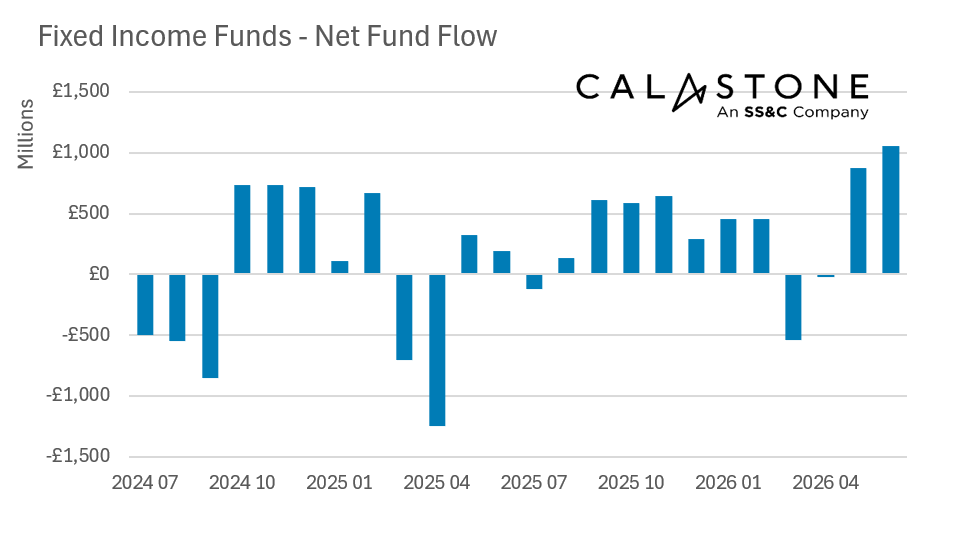
Strong demand for fixed income
Bond funds attracted £1.06bn of net inflows in June, making it the third-strongest month for fixed income funds on record, according to the latest Fund Flow Index from Calastone, the largest global funds network, as investors continued to rebalance portfolios towards assets offering income and diversification and away from highly valued equity markets.
Equity funds shed £437m despite steady markets
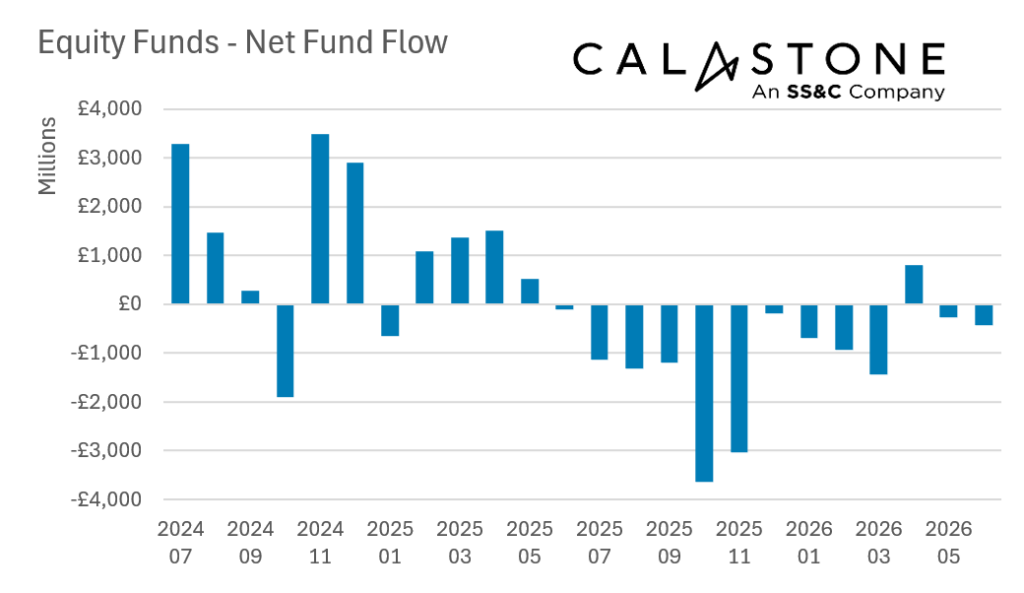
Strong demand for fixed income funds came as equity funds suffered net outflows of £437m during the month despite equity markets themselves holding firm, ending June broadly flat.
Asia-Pacific equity funds suffer a record 38th consecutive month of outflows.
All equity fund sectors saw outflows in June, except global and North American funds, which gained £328m and £200m respectively. The weakest sector was Asia-Pacific, where investors sold down £312m of their holdings. June marked the 38th consecutive month of outflows for Asia-Pacific equity funds, the longest run of outflows for any fund sector (and now totalling £7.05bn since May 2023). Unloved UK-focused funds suffered £260m of outflows, more than reversing May’s rare inflow.
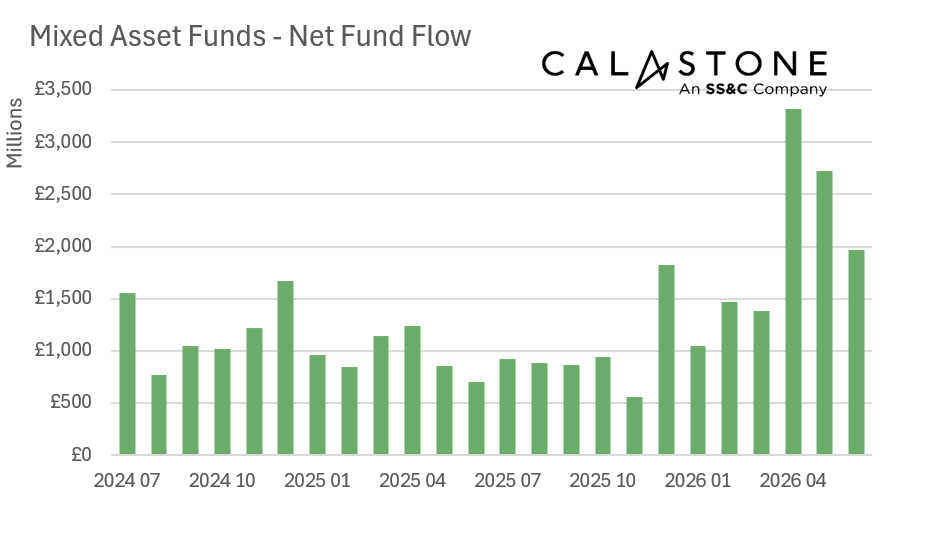
Multi-asset funds gained £1.97bn in June and a record £11.9bn in H1 2026
Meanwhile, multi-asset funds extended their remarkable run with £1.97bn of inflows. Money market funds returned to positive territory, attracting £215m of new cash.
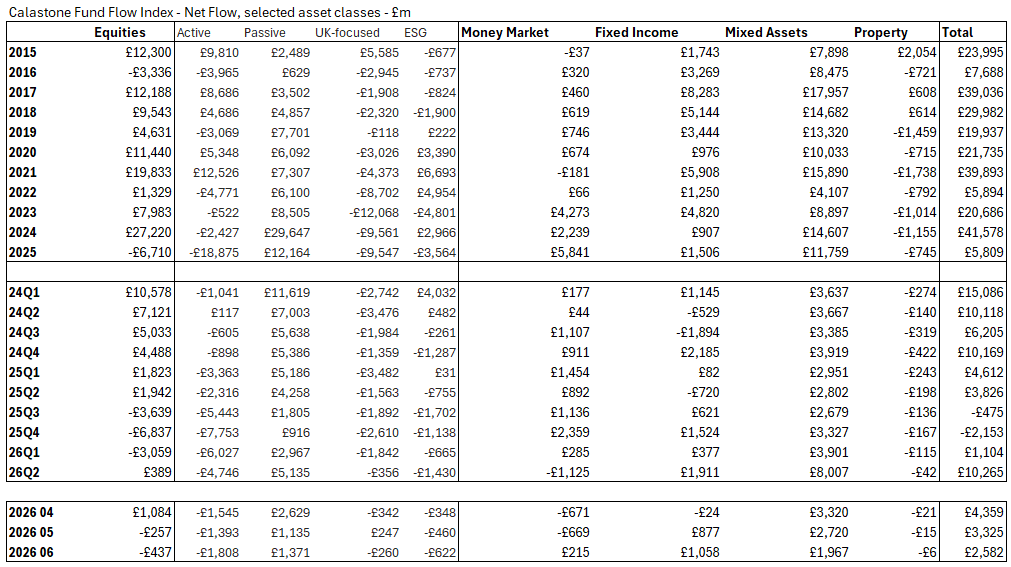
Bonds attracted £2.29bn in H1 2026, while equity funds saw £2.67bn of outflows and multi-asset funds enjoyed record inflows
The first half of 2026 tells the same story even more clearly. Bond funds have attracted £2.25bn of net new money so far this year, while equity funds have seen net outflows of £2.67bn. The standout performer has been the multi-asset sector, which has attracted a record-breaking £11.9bn during the first six months of the year, comfortably the strongest six-month period on Calastone’s record.
Edward Glyn, Head of Global Markets at Calastone, said: “Investors are still willing to take risk, but they’re becoming much more selective about how they do it. Rather than adding more money to equity markets after their strong run, many are building more balanced portfolios that combine growth potential with greater resilience.
“Bond funds are benefiting from an unusually attractive combination of high income and the prospect of capital gains if interest rates begin to fall. At the same time, geopolitical tensions, an uncertain economic outlook and elevated equity valuations are encouraging investors to rebuild the defensive side of their portfolios.
“The exceptional demand for multi-asset funds reflects the same theme. Investors increasingly want diversified portfolios at present without having to make big calls on whether stocks or bonds will outperform next. Multi-asset funds allow professional managers to adjust those allocations as market conditions evolve, making them an appealing choice at a time when the outlook remains unusually uncertain.
“Cash funds continue to attract some inflows, but the much stronger demand for bonds and multi-asset strategies suggests investors are moving beyond simply preserving capital. They are looking for portfolios that can generate returns while remaining resilient if markets become more volatile.”
Methodology
Calastone’s Fund Flow Index (FFI) is the most widely followed, most timely, and most comprehensive tracker of fund flows in the UK. Because it relies on real trading data by investors, rather than survey opinion, it is also the most accurate.
The FFI analyses millions of buy and sell orders in individual funds every month from millions of UK-based investors. More than 85% of all UK fund flows by value pass across Calastone’s network. To avoid double-counting, however, the analyst team excludes funds of funds. Totals are scaled up for Calastone’s market share.
Net fund flows are the difference between the value of investor buy orders and investor sell orders. The value of buy orders and the value of sell orders are both very large – the net flow is typically very small in comparison to this large amount of trading activity.
Calastone only measures orders from UK-based investors into funds domiciled in the UK. Note that this has nothing to do with where the underlying assets are invested – a UK-domiciled fund may invest in Japanese equities, Australian fixed income, a global portfolio of mixed assets, or just UK equities. The fund sector information breaks this down in detail.
Calastone uses the FE Fundinfo dataset to assign characteristics such as fund sector, or active v passive to each fund. Before December 2024 Calastone used Lipper for this function. Calastone has restated all historic data with the new FE Fundinfo data to ensure consistency. The new FE FundInfo provides enhanced coverage, and now includes many funds that are not classified by Lipper. The new FFI is therefore even more comprehensive than before, and the historic data now reflects this improvement. Calastone’s analysts do not judge there to be any material differences in the trends revealed using FE FundInfo classifications v Lipper, though there are minor points of detail that differ in individual months.
Calastone also calculates an index value to enable comparison between different asset classes and fund sectors of different sizes. A reading of 50 indicates that buy and sell orders are equal in value. A reading above 50 means capital is flowing in and a reading below 50 means it is flowing out. In other words, a net inflow of £1m would score much more highly if it is the difference between, say £10m of buys and £9m of sells than if it was the difference between £100m of buys and £99m of sells.