


UK investors drove near-record demand for mixed asset funds in May and the strongest fixed income inflows in three years, according to the latest Fund Flow Index from Calastone, the largest global funds network. Investors moved money out of money market funds while also trimming equity exposure, reallocating towards income-producing and diversified assets during the month.
Bond yields draw investors back into fixed income
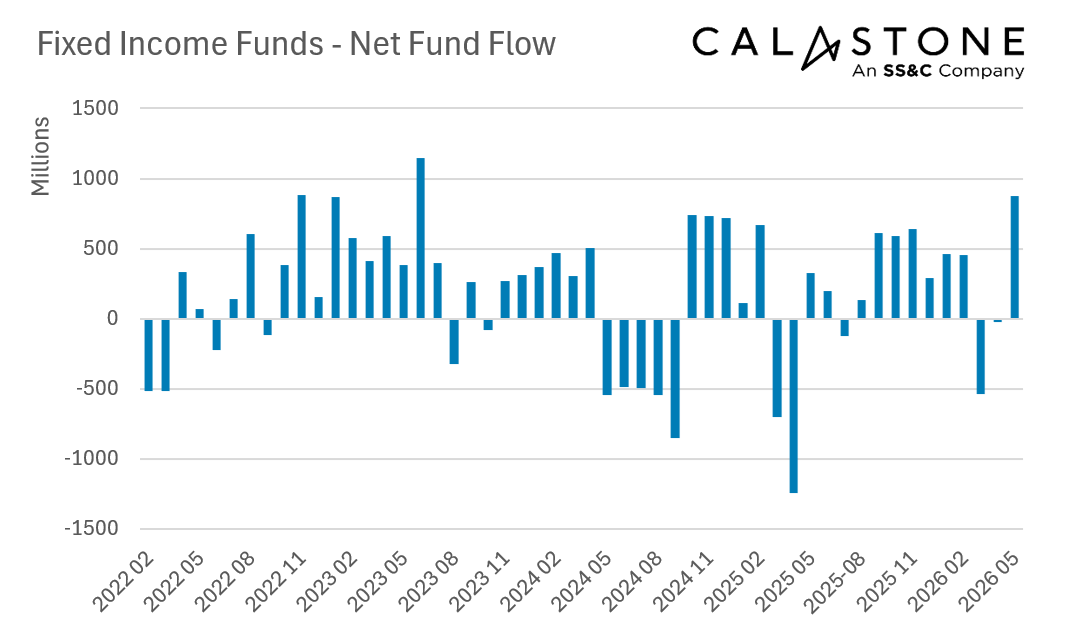
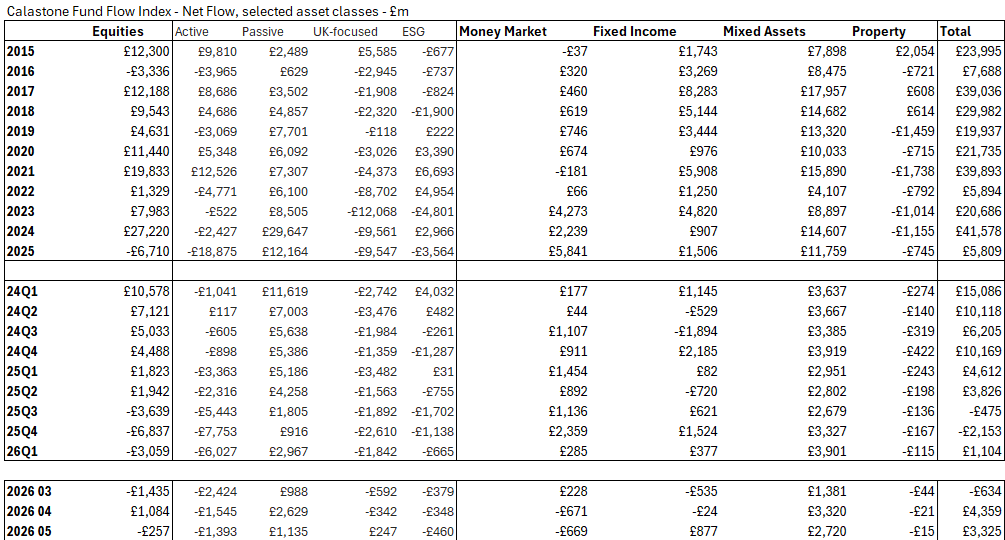
Most notably, surging bond yields drove investors decisively back into fixed income, with bond funds attracting their strongest monthly inflows since June 2023. Investors added a net £877m to their bond-fund holdings, the sixth best month for the sector on Calastone’s 12-year record. The strong inflow to bond funds was matched closely by substantial outflows from money market funds – reaching a net £669m for the month, the third worst month for the sector on record.
Edward Glyn, head of global markets at Calastone said: “Bond markets bottomed out in the middle of the month as yields touched highs last seen before the Global Financial Crisis. This offered an enticing opportunity to switch out of safe-haven money market funds whose returns mirror central bank policy rates and to lock into those multi-year high yields for the longer term.”
Strong demand for diversification
In an aligned move that showed investors spreading risk across asset classes, they also strongly favoured multi-asset funds in May, adding a net £2.72bn, the second-best month on record for the sector following the record inflow in April (£3.32bn).
Equity outflows also show reduced risk appetite
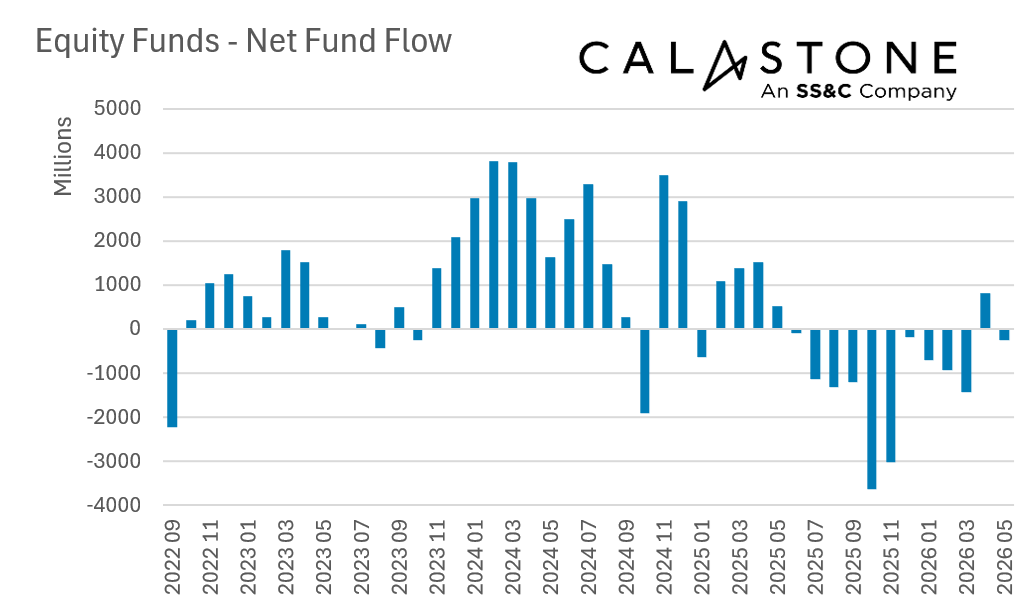
By contrast, equity funds saw selling pressure build again after the brief reversal in April. They saw net redemptions of £257m overall, driven primarily by outflows from emerging market (-£390m), European (-£213m), and Asia (-£232m) equity strategies. Once the most favoured equity strategy, global equity funds were flat over the month (+£51m) and have added almost no net new capital in the last 14 months, while US equity funds remained in positive territory, attracting £238m as the stock market there accelerated once again after a positive earnings season from technology titans.
UK equities see rare inflow
In a surprise reversal, UK-focused equity funds saw a net inflow for the first time since November 2024[1], focussed on a handful large index funds. This positive month marks a notable break in trend after a prolonged period of domestic equity withdrawals.
Edward Glyn commented on the overall picture for the month: “May’s data suggests investors were putting money back to work, but not without caution. Significant outflows from cash funds with strong inflows into both fixed income and multi-asset funds indicate that investors were ready to redeploy capital, but many chose diversification over concentration, favouring strategies that balance income, resilience, and flexibility. Multi-asset funds in particular offer a route into markets without requiring a high-conviction call on any one region or asset class. They have been strongly in favour all year.
“Equity flows reflect that same caution – modestly reducing risk by withdrawing capital and then being picky on where to place it. Investors continued to favour the US, while pulling back from emerging markets, Europe, and Asia. The inflow to UK equity funds is encouraging and may indicate sentiment towards domestic assets is becoming less negative, but it was narrowly focused, therefore it’s too soon to call it a broader trend. Overall, May looked less like a return to risk and more like a carefully managed re-entry into markets.”
[1] The November 2024 inflow was merely an investor re-adjustment following huge pre-Budget outflows the month before
Methodology
Calastone’s Fund Flow Index (FFI) is the most widely followed, most timely, and most comprehensive tracker of fund flows in the UK. Because it relies on real trading data by investors, rather than survey opinion, it is also the most accurate.
The FFI analyses millions of buy and sell orders in individual funds every month from millions of UK-based investors. More than 85% of all UK fund flows by value pass across Calastone’s network. To avoid double-counting, however, the analyst team excludes funds of funds. Totals are scaled up for Calastone’s market share.
Net fund flows are the difference between the value of investor buy orders and investor sell orders. The value of buy orders and the value of sell orders are both very large – the net flow is typically very small in comparison to this large amount of trading activity.
Calastone only measures orders from UK-based investors into funds domiciled in the UK. Note that this has nothing to do with where the underlying assets are invested – a UK-domiciled fund may invest in Japanese equities, Australian fixed income, a global portfolio of mixed assets, or just UK equities. The fund sector information breaks this down in detail.
Calastone uses the FE Fundinfo dataset to assign characteristics such as fund sector, or active v passive to each fund. Before December 2024 Calastone used Lipper for this function. Calastone has restated all historic data with the new FE Fundinfo data to ensure consistency. The new FE FundInfo provides enhanced coverage, and now includes many funds that are not classified by Lipper. The new FFI is therefore even more comprehensive than before, and the historic data now reflects this improvement. Calastone’s analysts do not judge there to be any material differences in the trends revealed using FE FundInfo classifications v Lipper, though there are minor points of detail that differ in individual months.
Calastone also calculates an index value to enable comparison between different asset classes and fund sectors of different sizes. A reading of 50 indicates that buy and sell orders are equal in value. A reading above 50 means capital is flowing in and a reading below 50 means it is flowing out. In other words, a net inflow of £1m would score much more highly if it is the difference between, say £10m of buys and £9m of sells than if it was the difference between £100m of buys and £99m of sells.