Asian investors consistently added to equity funds during the first half of 2026 while sharply reducing allocations to fixed income, signaling a meaningful shift in portfolio positioning following the defensive stance that characterised much of 2025, according to the latest fund flow data from Calastone, the largest global funds network.
Having prioritised fixed income through much of last year, investors have entered 2026 with a more growth-oriented approach. Equity funds attracted net inflows in every month of the first half, rising more than ninefold to US$7.3bn[1] from approximately US$0.8bn in the same period last year. On the other hand, fixed income funds moved into net outflows of US$3.1bn in the first half, suggesting investors are becoming increasingly comfortable increasing exposure to growth assets as global markets continued to demonstrate resilience.
Justin Christopher, Head of Asia at Calastone, said:
“One of the biggest changes we’ve seen this year is not simply stronger demand for equities, but a much weaker appetite for fixed income than we saw throughout 2025. Despite ongoing trade tensions, conflict in the Middle East and continued uncertainty around interest rates, investors appear increasingly comfortable looking beyond short-term macro events. Strong equity market performance, underpinned in part by continued investment in AI and technology, has encouraged investors to focus on longer-term growth opportunities rather than individual headlines.”
Equity funds attract consistent inflows throughout H1
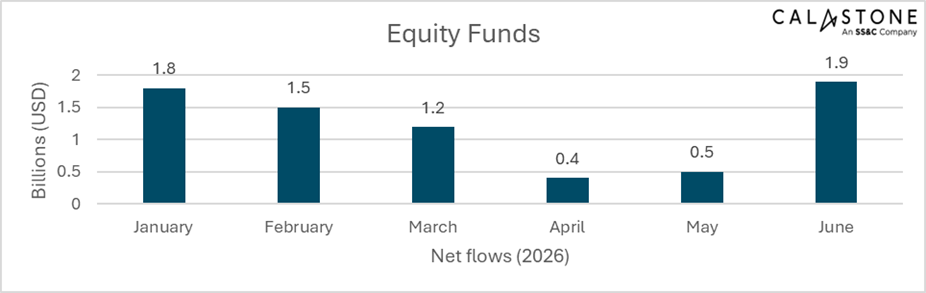
Equity funds recorded US$7.3bn of net inflows during the first half of 2026, attracting new money in every month of the period. Inflows cooled in April and May before rebounding sharply in June – the strongest month of H1, with net inflows of US$1.9bn.
The pattern represents a marked contrast with 2025, when the Trump administration’s tariff announcements prompted investors to reduce equity exposure during the second quarter before confidence gradually returned later in the year. By comparison, the first half of 2026 suggests investors have become increasingly comfortable maintaining equity allocations despite ongoing geopolitical uncertainty. The continued resilience of global equity markets appears to have reinforced confidence in growth assets.
Fixed income demand reverses as investors rebalance portfolios
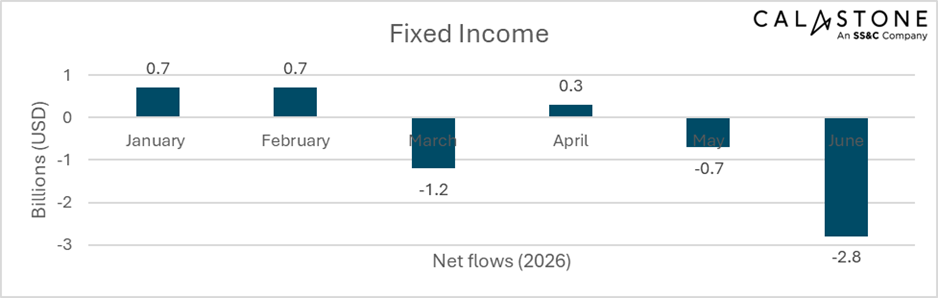
Fixed income experienced a notable shift in the first half of 2026 compared with the same period last year, recording US$3.1bn of net outflows in H1 2026 – a sharp reversal from the approximately US$16.1bn of net inflows fixed income attracted in H1 2025[2], a swing of over US$19.2bn in just twelve months.
Following modest inflows in January and February, bond funds moved into net outflows in March before weakening further in May and June. June recorded the largest monthly outflow of the period (US$2.8bn), suggesting investors increasingly rotated away from defensive allocations as confidence in equity markets strengthened.
Multi-asset funds continue to attract strong demand
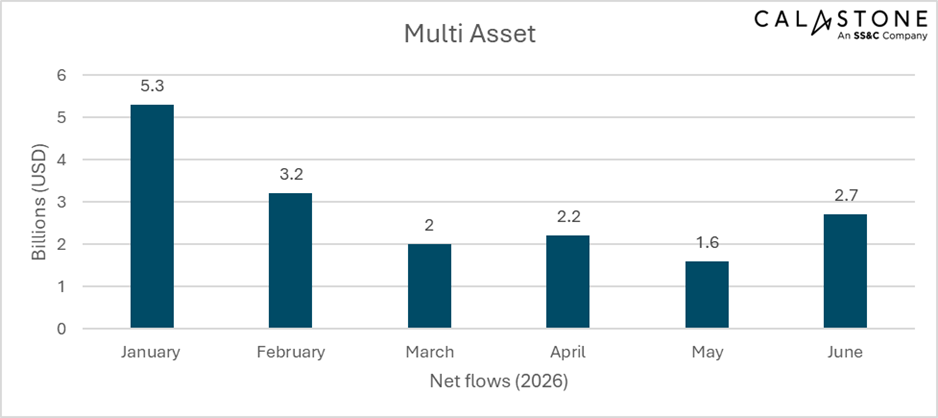
Multi-asset funds remained the strongest-performing asset class during the first half, attracting US$17.0bn of net inflows and recording positive flows in every month, more than four times the combined net flows of equity and fixed income funds.
The consistency of demand suggests investors are increasing exposure to growth assets while continuing to value diversification, rather than adopting an outright risk-on approach. Instead of abandoning balanced portfolios, investors appear to be complementing them with greater equity exposure as market confidence improves.
Justin Christopher added:
“The data doesn’t suggest investors are becoming complacent. Rather, it points to a more balanced approach to portfolio construction. Investors continue to value diversification, but they’re becoming increasingly selective about where they allocate capital. The sharp rotation away from fixed income alongside sustained demand for equities and multi-asset strategies suggests confidence is returning in a measured way, rather than through wholesale risk-taking.”
About Calastone, an SS&C Company
Calastone is the largest global funds network, connecting the world’s leading financial organisations.
Calastone’s mission is to reduce complexity, risk and costs, enabling the industry to deliver greater value to investors. 4,500 clients in 58 countries and territories benefit from Calastone’s services, processing over £300 billion of investment value each month.
Calastone is headquartered in London and has offices in Luxembourg, Hong Kong, Taipei, Singapore, New York and Sydney.
Calastone is a wholly owned subsidiary of SS&C Technologies Holdings, Inc. (Nasdaq: SSNC), a global provider of software and services for the financial services and healthcare industries.
Methodology
This report analyses fund transaction data across the Calastone network for Asia between January and June 2026, covering both subscriptions and redemptions initiated by fund distributors based in the region. Each order typically reflects aggregated activity from multiple underlying client trades, providing a detailed view of fund allocation patterns across the region.
The figures represent only the volumes transacted over the Calastone network and have not been adjusted for market share. Nonetheless, given the scale and granularity of the data, we are confident that the trends observed are broadly representative of wider market activity in Asia.
All data is based on the location where the order was placed, not where the fund is domiciled or executed.
[1] 2025 FULL YEAR CALASTONE ASIA FUND FLOW DATA: FIXED INCOME POWERS 2025 INFLOWS AS ASIAN INVESTORS PRIORITISE STABILITY
[2] 2025 FULL YEAR CALASTONE ASIA FUND FLOW DATA: FIXED INCOME POWERS 2025 INFLOWS AS ASIAN INVESTORS PRIORITISE STABILITY